
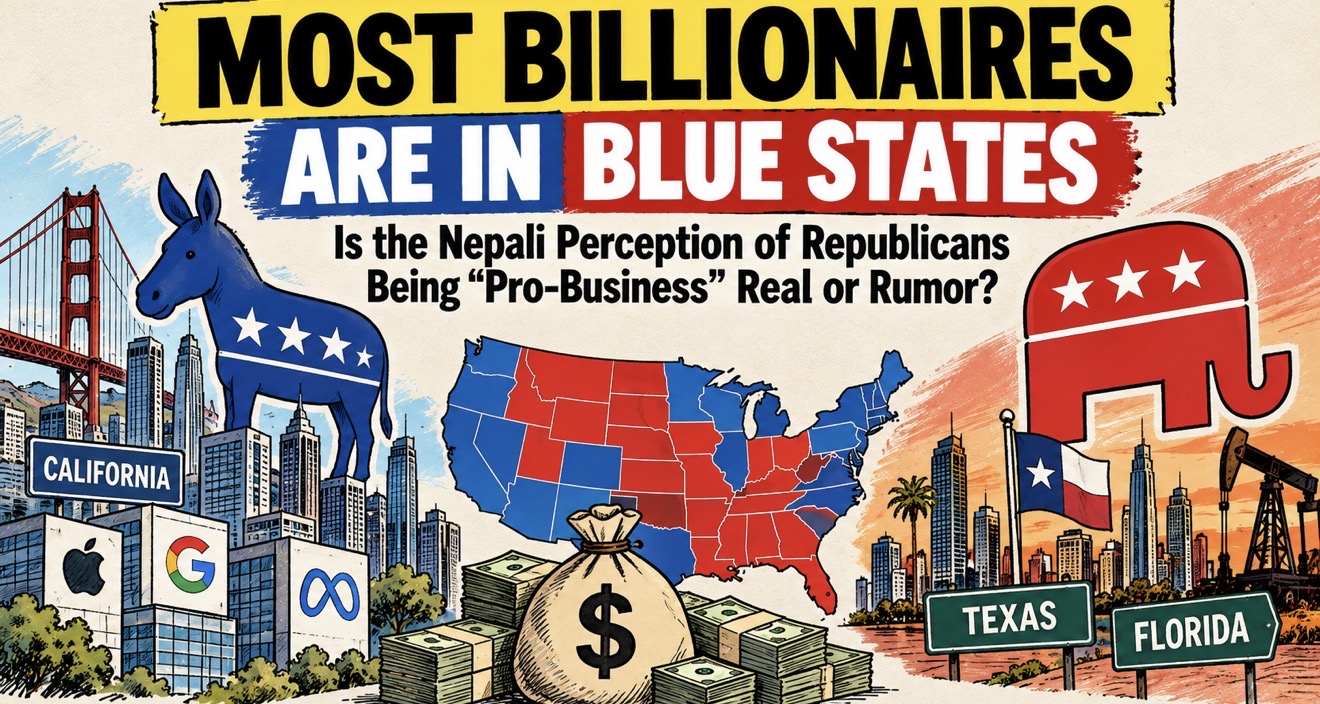

Is the Nepali Perception of Republicans Being “Pro-Business” Real or Rumor?
By Ramchandra Bhatta
Every year, Forbes magazine, now primarily an online publication, releases its global list of billionaires. According to the list published a few months ago, there are 3,428 billionaires worldwide this year.
These individuals are not billionaires in Nepali or Indian rupees, Chinese yuan or any other currency. Their net worth exceeds $1 billion in US dollars, the currency most commonly used to measure global wealth.
Among them are 989 Americans. While the combined wealth of billionaires worldwide stands at approximately $20 trillion, American billionaires alone account for $8.4 trillion of that wealth.
Where do these nearly 1,000 American billionaires live? What kind of homes do they own? How do they spend such enormous fortunes?
These are natural questions about the lives of the ultra-rich. But this article is less concerned with how billionaires spend their money than with where they live, where their wealth was created and what those locations tell us about American politics and business.
Through that lens, another question emerges: Is the widely held belief that Republicans are inherently more “business-friendly” actually supported by the evidence?
Where Do America’s Billionaires Live?
Billionaires reside in 47 of the 50 US states. Only three states—Alaska, Delaware and West Virginia—have no billionaires.
Of those three, Alaska and West Virginia are traditionally Republican states, while Delaware is governed by Democrats.
Among the remaining 47 states, California has the highest concentration of billionaires. The West Coast state is home to nearly 200 billionaires. From Silicon Valley to Hollywood, California has developed into a global centre for technology, biotechnology, entertainment and innovation.
New York ranks second, with about 140 billionaires. It remains a global centre for financial trading, real estate, Wall Street and media—a 24-hour financial capital of the world.
Florida ranks third with 115 billionaires, followed by Texas with 88.
Beyond these four states, Illinois, Massachusetts, Pennsylvania, Georgia, Nevada, Connecticut, Washington, Arizona and Colorado each have double-digit billionaire populations.
The geographic distribution raises an obvious question.
If Republican policies are inherently more favourable to business, why are so many of America’s wealthiest people and most successful companies concentrated in states governed by Democrats?
Is the Republican Party Truly the Only Business-Friendly Party?
A particular perception exists within parts of the Nepali-American community, especially among naturalised citizens. Republican politicians themselves have frequently promoted the idea that their party is more supportive of business.
During election cycles, campaign advertisements often portray Democrats as anti-business while presenting Republicans as the party of economic growth, lower taxes and entrepreneurship.
Among Nepali entrepreneurs in America—from gas-station owners to restaurant operators—this perception has become deeply rooted.
Many small and medium-sized business owners from Nepal view Democrats as the party of higher taxes and Republicans as the party of tax cuts.
There is another perception as well: that Democrats primarily support people who do not work by expanding food stamps and other government welfare programmes. Under this view, the taxes paid by hard-working Americans are simply transferred to people who are unwilling to work.
But how accurate are these perceptions?
What Does the Billionaire Data Tell Us?
To examine these beliefs, we can begin with the billionaire data.
As noted earlier, California has the largest concentration of billionaires in the United States—nearly 200. Yet California is also one of the country’s strongest Democratic states and a centre of Democratic political influence.
It was in this state that Elon Musk built much of his fortune.
California’s aggressive clean-energy and electric-vehicle policies created an environment in which Tesla could expand rapidly. Long-term state policies aimed at reducing carbon emissions and addressing climate change—including government incentives for electric vehicles—helped create demand for EVs.
Musk later moved to Texas, a state with no individual state income tax, after accumulating enormous wealth. But the California business environment played a major role in Tesla’s development and growth.
Musk is not an isolated example.
Mark Zuckerberg built Facebook and his fortune in California. Apple has operated in the state since its inception. Nvidia grew into a global technology giant in California, while its co-founder and CEO, Jensen Huang, became one of the world’s wealthiest technology executives.
Google, founded by Larry Page and Sergey Brin, also emerged from California. The Android operating system, which later became one of the world’s dominant mobile platforms, was developed within the broader California technology ecosystem.
If California’s Democratic political environment is inherently hostile to business, how did so many of the world’s most successful technology companies emerge there?
New York and Washington Tell a Similar Story
New York provides another example.
New York is a Democratic-leaning state, yet it has produced some of America’s most prominent billionaires and business leaders, including Michael Bloomberg and Donald Trump.
Washington state offers another case.
Microsoft flourished there, helping make Bill Gates one of the world’s richest people for years. Amazon’s Jeff Bezos also built his business empire in Washington. Starbucks grew into a global brand from Seattle.
Boeing, meanwhile, established major manufacturing operations in Washington and became deeply connected to the state’s industrial economy.
These examples raise another question:
In what way have these blue states, or Democratic administrations governing them, prevented business development?
The answer is not straightforward.
Why Do Billionaires Move to Red States?
There is another side to the story.
Wealthy individuals frequently seek ways to reduce their tax burdens. Their relocation to states such as Texas and Florida can therefore be influenced by differences in taxation rather than by political allegiance.
Jeff Bezos, for example, moved to Florida, a Republican-led state.
Texas and Florida can operate without a state individual income tax because they have other substantial sources of revenue.
Texas, for example, relies heavily on property taxes, sales taxes, franchise taxes and revenues connected to its energy sector. The state’s oil and natural-gas industries contribute billions of dollars in taxes and royalties to state and local governments.
Texas is also one of the country’s largest energy-producing states.
These revenue sources allow Texas to maintain a state-level tax structure that does not include an individual income tax.
For someone earning hundreds of millions or billions of dollars, the difference between states can be enormous.
When a business generates hundreds of billions of dollars in revenue, even a relatively small difference in taxes can translate into billions of dollars.
This helps explain why some wealthy Americans relocate to states such as Texas and Florida.
It does not necessarily mean that they have changed their political ideology or moved because they want to create jobs in those states. Tax considerations can be a significant factor.
Therefore, the argument that Republicans are inherently more business-friendly simply because billionaires relocate to Republican-led states deserves closer examination.
The larger question is what economic data tells us about business growth, employment and the broader economy under different political administrations.
Democratic and Republican Economic Performance
A Princeton University study by economists Alan Blinder and Mark Watson examined the performance of the US economy under Democratic and Republican presidents following World War II.
Their research found that economic growth was substantially higher, on average, during Democratic administrations than Republican administrations.
Real GDP growth averaged roughly 4.3 percent under Democratic presidents compared with about 2.5 percent under Republican presidents during the periods examined by the study.
The study examined several possible explanations for this difference, including oil shocks, productivity, international economic conditions and consumer expectations.
The broader point remains relevant: economic performance cannot simply be reduced to the claim that Republican governments are automatically better for business.
If Republican political affiliation alone guaranteed business success, one might expect states such as West Virginia and Alaska—both strongly Republican states—to have large concentrations of billionaires.
They do not.
This does not mean that Republican states cannot produce successful businesses. They clearly can.
Rather, billionaire concentration demonstrates that many factors—including access to capital, universities, infrastructure, skilled workers, natural resources, technology ecosystems and consumer markets—shape where businesses succeed.
Blue States, Red States and Billionaires
Across the United States, the article’s billionaire figures show a greater concentration of billionaires in blue states than in red states.
If Republicans were the only political group genuinely committed to business success, one might expect Republican-led states to dominate the billionaire rankings.
But they do not.
The distribution is much more complicated.
California and New York have large concentrations of billionaires despite being Democratic strongholds. Texas and Florida have also attracted large numbers of wealthy individuals despite their Republican political orientation.
This suggests that wealth creation and wealth migration are not determined by political party alone.
What About Business Failures?
The same argument applies to business failures.
If Republican policies guaranteed business success, retail closures should not be occurring in Republican-led states.
Yet thousands of retail stores closed across the United States in 2025.
Companies such as Big Lots, Party City, Rite Aid, 99 Cents Only and Forever 21 experienced bankruptcy, restructuring or widespread store closures.
These companies operated across different political jurisdictions.
Their struggles demonstrate that business success depends on far more than whether a state is controlled by Republicans or Democrats.
Consumer behaviour, inflation, interest rates, competition, debt, online shopping, labour costs and management decisions can all influence whether a company survives.
SNAP Restrictions and Small Businesses
The debate becomes even more complicated when considering government programmes and small businesses.
Several Republican-led states have recently introduced policies restricting the use of SNAP benefits to purchase certain products, including soda and other snacks.
These policies are intended, among other things, to influence dietary choices and public health.
But they can also affect businesses that depend heavily on SNAP customers.
Small grocery stores, convenience stores and rural gas stations may be particularly sensitive to changes in customer spending patterns. Some of these businesses are owned and operated by immigrant entrepreneurs, including Nepali Americans.
For a small business, losing a portion of its customer spending can have a significant impact.
This illustrates an important point: policies designed to help consumers or taxpayers can also have unintended consequences for businesses.
Supply-Side vs Demand-Side Economics
The Republican reputation for being “pro-business” is often associated with policies favouring lower taxes, deregulation and a reduced role for government.
Republican economic policy has traditionally placed greater emphasis on investors, business owners and capital formation, including policies intended to reduce corporate taxes and regulatory burdens.
This approach is often associated with Supply-Side Economics, sometimes described as “trickle-down economics”.
The underlying theory is that reducing taxes on businesses and wealthy individuals will encourage investment, entrepreneurship and job creation.
But in today’s globalised economy, critics argue that the benefits do not always remain within the domestic economy.
Democrats, by contrast, generally place greater emphasis on Demand-Side Economics—the idea that increasing consumer purchasing power can stimulate economic activity.
The argument is straightforward: when workers earn more money, they spend more money. Higher consumer spending increases demand for goods and services, which can ultimately benefit businesses.
Thus, the two parties often approach economic policy from different directions.
Republicans tend to emphasise the supply side—capital, investment, taxation and regulation.
Democrats tend to place greater emphasis on demand—wages, consumer purchasing power, public investment and government programmes.
The debate over which approach produces stronger long-term economic results remains a central issue in American politics.
Where Does the Money Go?
Republicans often argue that tax reductions encourage companies to reinvest their savings.
But American corporations also operate in a global economy.
Companies such as Tesla have made major investments outside the United States, including in China, Germany, Mexico and India. SpaceX and Starlink have also expanded their operations internationally.
At the same time, wealthy Americans continue to purchase major properties around the world.
Meta CEO Mark Zuckerberg, for example, purchased a luxury estate in Ireland, prompting discussion about the relationship between American wealth, taxation and overseas investment.
The broader question is whether tax incentives intended to encourage domestic investment always result in money being reinvested inside the United States.
The answer is not necessarily.
The assertion that “only Republicans are business-friendly” is better understood as a political narrative than as an established economic fact.
If “business-friendly” is defined narrowly as lower taxes, deregulation and fewer restrictions on employers, Republicans have a stronger claim to that label.
But if the definition includes consumer purchasing power, infrastructure, economic stability, market size, public investment, technological ecosystems, GDP growth and long-term economic development, the picture becomes considerably more complicated.
The experiences of California, New York, Washington, Texas and Florida demonstrate that businesses can flourish under very different political and economic environments.
The world’s richest people do not all live in Republican states.
Many of the world’s most successful companies were created in Democratic states.
And wealthy people sometimes move from one state to another because of taxes, costs, business conditions or lifestyle—not necessarily because of political loyalty.
A thriving business environment requires more than tax cuts.
It requires customers who can spend, workers who can participate in the economy, infrastructure that supports commerce, access to capital, technological innovation and a stable economic environment.
The debate over which political party is more “business-friendly” therefore cannot be settled simply by looking at campaign slogans or the political colour of the state where a billionaire chooses to live.
The evidence points to a more complicated reality.
Business success is rarely the product of one political party or one economic policy.

Feedback